ChemSpider SyntheticPages

The Royal Society of Chemistry"

Reductive Amination of Tryptophan

SyntheticPage 830

Submitted: September 22, 2017, published: October 5, 2017

Authors

Andrew Schneerer (schne586@umn.edu)

Nathaniel Olson (olso4006@umn.edu)

Wayland Noland (nolan001@umn.edu)

A contribution from 
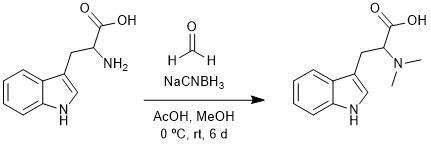
Reaction Scheme

Chemicals

Tryptophan (Reagent grade, 98%; Aldrich)
Methanol (ACS grade, 99.8%; Aldrich)
Sodium Cyanoborohydride
Acetic Acid (ACS grade, 99.7%; Mallinckrodt)
Formaldehyde

Procedure

Tryptophan (2.004 g, 9.812 mmol) was dissolved in methanol (100 mL) and acetic acid (2.4 mL). The solution was cooled to 0 °C, and formaldehyde in methanol solution (23.5 mL, 1 M) was added. Sodium cyanoborohydride (1.234 g, 19.65 mmol) was added and then the reaction was warmed to room temperature. The solution was stirred for 6 days after which the solvent was removed under reduced pressure to give a white powder. Recrystallization from methanol and water afforded slightly orange-white crystals (1.664 g, 73%).

Author Comments

The solution probably does not need to be stirred for the full 6 days. TLC can be used to determine when the reaction is complete. The white powder isolated after removal of the solvent is heavily contaminated with sodium acetate which gives a large singlet at 1.97 ppm in D2O or 1.91 ppm in DMSO-d6. The recrystallization can be performed by dissolving the crude product in an 1:1 mixture of water and methanol at room temperature in a beaker, covering the beaker with a watch glass and allowing the solvents to partially evaporate over about 5 days. At this point the remaining solvent mixture can be decanted off and another round of recrystallization can be performed if it is necessary. One round of recrystallization using this method was sufficient enough to remove most of the remaining sodium acetate as illustrated in the attached 1H NMR spectrum in which the sodium acetate peak integrated to 0.02 H. Only dimethyltryptamine could be detected in the mass spectrum of the dimethyltryptophan due to decarboxylation in the solids probe of the GCMS instrument.

Data

Rf = 0.10 (Al2O3, 17:2:1 CHCl3:MeOH:AcOH

M.p. 230 ºC dec.

1H NMR (500 MHz, DMSO): δ 10.887 (s, br., 1H), 7.551 (d, J = 8.0, 1H), 7.335 (d, J = 8.3), 7.178 (d, J = 2.2, 1H), 7.059 (t, J = 7.5), 6.974 (t, J = 7.5, 1H), 3.504 (dd, J = 8.0, 6.1, 1H), 3.189 (dd, J = 14.7, 8.3, 1H), 2.997 (dd, J = 14.8, 6.0, 1H), 2.440 (s, 6H)


13
C NMR (126 MHz, DMSO) δ 170.94, 136.07, 127.17, 123.46, 120.83, 118.26, 118.23, 111.35, 110.37, 68.53, 41.28, 24.32

IR (KBr, cm-1) 3244, 3048, 2959, 2919, 1623, 1484, 1458, 1439, 1352, 1288, 1239, 1172, 1147, 1032, 1013, 769, 756, 738 cm-1

MS (CI, m/z) [M-CO2]+ calculated for C12H17N2+ 189.1386, found 189.1386.

Anal. Calcd for C13H16N2O2: C, 67.22, H, 6.94, N, 12.06. Found: C, 66.95, H, 6.91, N, 12.01

Lead Reference

Qu, S.; Wang, G.; Duan, W.; Yao, S.; Zuo, J.; Tan, C.; Zhu, D.; Bioorg. Med. Chem. 2011, 19, 3120-3127

Keywords

aldehydes, amines, heterocyclic compounds, indole, reductive amination, tryptophan