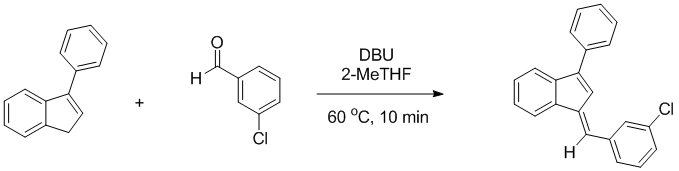
Olefination of 3-phenyl-1H-indene to Benzofulvene
SyntheticPage 779
DOI:
Submitted: May 6, 2015, published: May 8, 2015
Authors
Adam Glass (glassac@plu.edu)
Christian Rude (rudeci@plu.edu)
John Fordice (fordicjw@plu.edu)
Katie Caspary (casparke@plu.edu)
A contribution from
Chemicals
3-phenyl-1H-indene (Prepared in House by method of SP696)
3-chlorobenzaldehyde (Oakwood Chemical, 95%)
1,8-Diazabicyclo[5.4.0]undec-7-ene "DBU" (TCI, 98%)
2-MeTHF (Sigma-Aldrich, HPLC grade)
Procedure
The synthesis was performed under ambient atmosphere. To a microwave reaction vial charged with indene (0.204 g, 1.06 mmol) was added 3-chlorobenzaldehyde (0.154 g, 1.10 mmol), DBU (0.172 g, 1.13 mmol), and 2-MeTHF (2 mL, 0.53 M). The vial was then heated via variable watt microwave irradiation to 60 °C for 10 minutes with a 30 second pre-stirring period. Upon completion a yellow sheen was observed on the sides of the vial. The reaction mixture was quenched using a silica plug. The solvent was removed under reduced pressure. The crude mixture was purified via preparative chromatography, (90:10 hexane:toluene) yielding the title compound as a crimson red solid, (0.190 g, 58%).
The synthesis was also performed on a 100 mg scale (indene) yielding 90 mg of the title compound (55%).
Author Comments
3-chlorobenzaldehyde should be added before the DBU, and the time between the addition of the DBU and microwave heating should be minimized in order to maximize yield.
Data
1H NMR (CDCl3, 500 MHz): δ ppm 7.06 (s, 1H), 7.29-7.36 (m, 4H), 7.39-7.44 (m, 2H), 7.46-7.51 (m, 3H), 7.59-7.62 (m, 2H), 7.69-7.75 (m, 3H)
13C NMR (CDCl3, 125 MHz): δ ppm 119.5, 120.5, 122.5, 125.7, 126.2, 127.60, 127.7, 128.1, 128.2, 128.31,128.6, 129.8, 129.9, 134.6, 135.4, 138.6, 138.8, 140.3, 140.8, 148.3
GC-MS EI [M.+]: Predicted: 314.09, Actual: 314; Predicted: 315.09 Actual: 315; Predicted: 316.08, Actual: 3161
Supplementary Information
Keywords
aldehydes, alkenes, aromatics/arenes