ChemSpider SyntheticPages

The Royal Society of Chemistry"

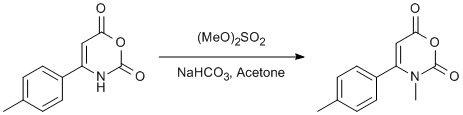
Oxazine-2,6-dione N-methylation with dimethyl sulfate

SyntheticPage 529

Submitted: January 15, 2012, published: January 16, 2012

Authors

Reaction Scheme

Chemicals

4-(4-Methylphenyl)-1,3(3H)-oxazine-2,6-dione (J. Org. Chem., Vol 40, p 375 (1975). DOI: 10.1021/jo00894a016)
Dimethyl sulfate, (99%, Sigma Aldrich)
Sodium bicarbonate (99.7%), A.C.S. Reagent, Sigma Aldrich)
Acetone (99.5%, A.C.S. Reagent, Sigma Aldrich)
Ethyl acetate (99.5%, A.C.S Spectrophotometric grade, Sigma Aldrich)
Hexane (99%, Sigma Aldrich)

Procedure

A 100 ml 3neck round bottom flask equipped with heating mantle, dinitrogen inlet, water cooled dropping funnel, magnetic stirrer and calcium chloride drying tube was charged with 4-(-Methylphenyl)-1,3(3H) oxazine-2,6-dione (2.4 g, 0.012 mol), dimethyl sulfate (3.0 g, 0.024 mol), sodium bicarbonate (2.5 g, 0.031 mol) and acetone (50 ml). The mixture was heated to reflux under dinitrogen and monitored by thin layer chromatography (silica gel, ethyl acetate eluent). After 20 h reflux the spot corresponding to the starting material had disappeared and a single new spot with higher Rf value was prominent. The mixture was cooled to room temperature and the sodium carbonate fitered off under water aspirator pressure. The acetone was removed from the fitrate on a rotovap with water bath at 80° C and the residue taken up in 10 ml ethyl acetate. Hexane was added dropwise to the solution in an ice bath to permanent turbidity. Suction filtration gave 1.38 g, white crystals. The filtrate was concentrated to half volume and the above procedure repeated, giving a second crop. Total yield 1.72 g (66%).

Author Comments

Caution! Dimethyl sulfate is toxic and carcinogenic. Weigh and manipulate in a fume hood. Wear latex gloves. Other runs of this N-alkylation reaction with p-methylphenyl maleic anhydride, and with other alkyl, halo and aryl substituted-1,3(3H) oxazine-2,6-diones gave yields routinely in the 60-70% range. See lead reference and other references below.
Also see http://furlip.solidwebhost.com/Additional-unreportd-N-alkylated-oxauracils.htm
This reaction also N-ethylates 1,3(3H) oxazine-2,6-diones (oxauracils) with diethyl sulfate by the same synthetic procedure in yields of 50-70%. Uracils should readily mono and dialkylate in an analogous fashion.

Data

mp 99-100° C
Anal: Calc for C12H11NO C 66.35  H 5.10  N 5.65; Found: C 66.41  H 5.20  N 6.33
IR (CDCl3), 3120(w), 2960 (m), 1780(vs), 1720(vs), 1620(s), 1510(m), 1470(s), 1430(s), 1390(m), 1320(m), 1240(m), 1200(m), 1180(m), 1080(m), 1060(m), 1010(m), 1005(m),  960(m), 840(s), 800(m), cm-1.
1H NMR (CDCl3, 60mz), δ 7.3 (AB Pattern, 4H, aromatics), 5.50 (s, 1H, C5-H), 3.2 (s, 3H, N-CH3 ) 2.4 (s, 3H, phenyl-CH3).

13C NMR (DMSO-d6 ), δ 162.0, 159.2 (carbonyls), 151.2 (C-4 of oxauracil), 142.0, 130.1, 130, 128.5 (aromatics). 96.5 (C-5 of oxauracil), 34.8, (N-CH3), 20.8 (phenyl-CH3).

Lead Reference

James D. Warren, John H. MacMillan and Stephen S. Washburne, J. Org. Chem., Vol 40, p 375 (1975). DOI: 10.1021/jo00894a016

Other References

John H. MacMillan and Stephen S. Washburne, J. Heterocyclic Chemistry, Vol. 12, p 1215, (1975). DOI: 10.1002/jhet.5570120624

Keywords

1, 3(3H) oxazine-2, 6-diones, Alkylation, aromatics/arenes, heterocyclic compounds, Methylation, nucleosides, oxauacils, substitution