Large Scale Preparation of Indoline-2-ones by Friedel-Crafts Cyclisation
SyntheticPage 238
DOI:
Submitted: February 28, 2006, published: March 6, 2006
Authors
Ramappa. Chakrasali (chakrasa@ku.edu)
Chemicals
2,6-dichlorodiphenylamine (Aldrich), Chloroacetyl chloride (Aldrich),
Aluminium chloride (Aldrich), Toluene, Hexane
Aluminium chloride (Aldrich), Toluene, Hexane
Procedure
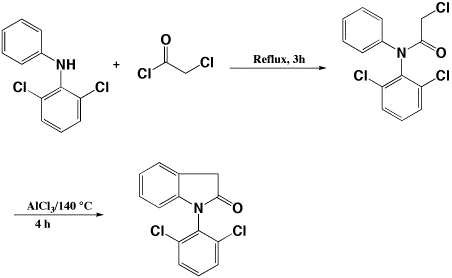
A mixture of 2,6-Dichlorodiphenylamine (120 g, 0.5 mol) and chloroacetyl chloride (297 g, 2.5 mol) are combined together in 500 mL round bottom flask and refluxed for 3 hours with stirring. At the completion of the reaction, excess acid chloride is distilled off at atmospheric pressure (178 g, 125 mL). Final portions of acid chloride are distilled under mild vacuum.
The hot (80 °C) reaction mixture is slowly poured into 250 mL of hexane with vigorous stirring. The precipitated product is filtered under suction, washed with 50 mL hexane and dried at 50-60 °C under vacuum (if required, filtrate be can be distilled to recover and reuse the hexane).
Yield of 2-chloro-N- (2’,6’-dichlorophenyl)-N-phenylacetamide is 150 g.
In the next step, 2-Chloro-N- (2’,6’-dichlorophenyl)-N-phenylacetamide (150 g, 0.47 mol) and aluminum chloride (155 g) were mixed in a 500 mL RB flask and the mixture was heated to 140 °C. At around 100 °C the reaction mixture becomes a stirrable mass and hydrogen chloride gas evolution starts (CAUTION). The reaction is maintained at 140 °C for 4 hrs, cooled to room temperature and toluene (300 mL) is added. The reaction mixture is heated on a water bath to dissolve the material in toluene. The toluene solution is slowly added to an ice-cold water with stirring, and stirring continued for 30 min. Toluene layer is separated and aqueous layer is extracted with another 100 mL of toluene. The combined toluene layers are evaporated to get the crude product, which was recrystallized from methanol to yield 100 g of 1-(2’, 6’-dichlorolphenyl) indolin-2-one.
Author Comments
This reaction has been carried out several times on 1 kilogram scale. In all the experiments, the consistent yields were obtained.
Data
1H-NMR (CDCl3): 7.51(A2 part of A2B, H-3 and H-5), 7.38 ( B part of A2B,H-4), 7.34 (dm,H-6’), 7.21 ( tm, H-4’), 7.10 (td,H-5’), 6.41( dm, H-3’), 3.78 (S, CH2).
Lead Reference
Moser, P.; Sallmann, A.; Wiesenberg, I.; J.Med. Chem. 1990,33,2358-2368
Other References
Sallmann, A.; Pfister, R. (Geigy, J. R., A.-G.) Brit.Pat.1,132,318, 1968
Keywords
Comments
This page reports the completion of first step after three hours reflux. I think, This type of reactions are usually reported in shorter time.Different solvents can also be used like Dichloro methane, DMF etc.The Paper(Bull. Korean Chem. Soc. 2005, Vol. 26, No. 3, 467) reports the completion of such reaction in One hour using CH2Cl2 solvent.
By Matloob Ahmad on January 9, 2008