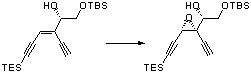
Sharpless asymmetric epoxidation of endiynes
SyntheticPage 212
DOI:
Submitted: April 8, 2003, published: April 24, 2003
Authors
Zac Etheridge (z.c.etheridge@sussex.ac.uk)
A contribution from
Chemicals
tert-butylhydroperoxide (5.5M soln in decane, fluka, 0.9 mmol, 0.164 mL)
titanium tetra-isopropoxide (distilled, 0.045 mL, 0.15 mmol)
(-)-diethyl tartrate (distilled, 0.032 mL, 0.19 mmol)
dichloromethane (distilled from calcium hydride)
powdered 3A molecular sieves (activated by bunsen burner)
enediyne (55 mg, 0.15 mmol)
titanium tetra-isopropoxide (distilled, 0.045 mL, 0.15 mmol)
(-)-diethyl tartrate (distilled, 0.032 mL, 0.19 mmol)
dichloromethane (distilled from calcium hydride)
powdered 3A molecular sieves (activated by bunsen burner)
enediyne (55 mg, 0.15 mmol)
Procedure
The enediyne is dissolved in DCM (2 mL), freshly activated molecular sieves added and the mixture stirred under nitrogen for 1 hour. Meanwhile to further freshly activated molecular sieves stirring in DCM (1.5 mL) at -18C is added the titanium tetraisopropoxide and the diethyl tartrate. This mixture is stirred for 1 hour then the TBHP added, folowed by the endiyne via canula. The mixture is allowed to warm to 0C and stirred for 15 hours then quenched with trimethylphosphite (1 mL) then 10% aqueous tartaric acid (2 mL) added. The organics are extracted 3 times with ether then washed with sodium bicarbonate solution and brine then dried over magnesium sulphate, filtered and concentrated. Column chromatography eluting with 5% ether/PE affords the product as a yellow oil (0.038g, 69%)
Author Comments
It is absolutley imperative this reaction is kept completely anhydrous. All reagents except TBHP must be freshly distilled, no matter what purity they are claimed to be. Molecular sieves should be freshly activated for several minutes by heating with a bunsen, then allowed to cool under nitrogen before use in drying the enediyne and in activating the DET/Ti(OiPr)4 mixture. A successful epoxidation will result in a lower spot by TLC, although it is possible to visualise both the DET and TBHP, so care should be taken that these are not being confused with the product.Note that in order for this reaction to be successful, the primary hydroxy group must be protected.
Data
1H NMR 3.82 (2H, d, J = 3.5, OCH2), 3.76 (1H, app. q, J = 3.5, OCH), 3.61 (1H, s, CCH), 2.40 (1H, s, CCCH), 2.29 (1H, d, J = 4.1, OH), 0.90 (9H, t, J = 7.9, (SiCH2CH3)3), 0.81 (9H, s, SiC(CH3)3), 0.51 (6H, q, J = 7.9, (SiCH2CH3)3), 0.00 (6H, s, Si(CH3)2).
Lead Reference
Hirama M., Iguchi S., Wang G.X., J. Org. Chem. 2001, 66, 2146
Other References
Sharpless K.B. et al J. Am. Chem. Soc. 1987, 109, 5765.