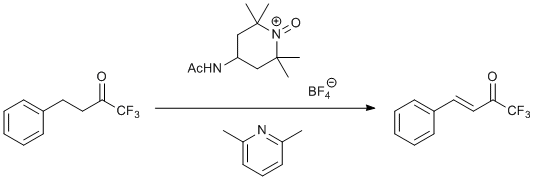
Dehydrogenation of Perfluoroalkyl Ketones by an Oxoammonium Salt
SyntheticPage 733
DOI:
Submitted: March 24, 2014, published: March 25, 2014
Authors
Christopher Kelly (christopher.kelly@uconn.edu)
Trevor Hamlin (trevorhamlin@gmail.com)
A contribution from
Chemicals
4-acetamido-2,2,6,6-tetramethylpiperidine-1-oxoammonium tetrafluoroborate (Prepared In-House, See Comment 1)
1,1,1-trifluoro-4-phenylbutan-2-one (Prepared In-House, See Comment 2)
2,6-lutidine (anhydrous, 99%, Sigma Aldrich)
dichloromethane (ACS reagent, 99.5%, Sigma Aldrich)
1,1,1-trifluoro-4-phenylbutan-2-one (Prepared In-House, See Comment 2)
2,6-lutidine (anhydrous, 99%, Sigma Aldrich)
dichloromethane (ACS reagent, 99.5%, Sigma Aldrich)
Procedure
To a 250 mL round-bottom flask equipped with a magnetic stir bar was added 1,1,1-trifluoro-4-phenylbutan-2-one (1.42 g, 7 mmol, 1 equiv.), 2,6-lutidine (1.65 g, 15.4 mmol, 2.2 equiv), and dichloromethane (0.1 M, 70 mL). The reaction mixture was sturred for 10 m, and the oxoammonium salt (5.46 g, 18.2 mmol, 2.6 equiv.) was added. The flask was the equipped with a relux condenser and the contents were stirred for 24 h at reflux. Once the reaction was deemed complete,3 the solvent was removed in vacuo to yield a thick red residue. Anhydrous diethyl ether (50 mL) was added to the flask and the mixture was allowed to stir vigourously for 10 m.4 Any large pieces of the solid were crushed into fine particles to release any trapped product into solution. The solution was then filtered through a fritted funnelto isolate the spent oxidant.5 The solid was washed thoroughly with anhydrous diethyl ether. The resulting filtrate was dry-packed on silica gel.6 The dry-packed material was loaded on to a pad of silica gel7 and rinsed with approximately 100-120 mL of hexane/EtOAc (95:5).8 The eluting solvent was removed in vacuo by rotary evaporation in a room-temperature water bath to afford the pure α,β-unsaturated trifluoromethyl ketone (0.9086 g, 65%) as a clear, yellow oil.
Author Comments
[1] The oxoammonium salt may be purchased from Sigma Aldrich (http://www.sigmaaldrich.com/catalog/product/aldrich/745537?lang=en®ion=US), but we prefer to prepare the oxidant in-house using the procedure detailed in this reference: Mercadante, M. A.; Kelly, C. B.; Bobbitt, J. M.; Tilley, L. J.; Leadbeater N. E. Nat. Protoc. 2013, 8, 666.
[2] Prepared from N-methoxy-N-methyl-3-phenylpropanamide using the protocol detailed here: Rudzinski, D. M.; Kelly, C. B.; Leadbeater, N. E. Chem. Commun. 2012, 48, 9610.
[3] Monitoring by GC-MS.
[4] This caused immediate precipitation of the spent oxidant. Sometimes you need to thoroughly scrape the sides of the flask to release the solids into the suspension.
[5] The spent oxidant can be recovered from this impure mixture and used to regenerate the oxoammonium salt. The following is a representative protocol for recovery: The solid material from one 5 mmol scale oxidations was transferred to a 50 mL round bottom flask equipped with stirbar. The flask was charged with 15 mL of CH2Cl2 and stirred for 5 minutes The solution became dark red and a fine white precipitate (pyridinium tetrafluoroborate) was observed. The solution was then filtered through a medium porosity fritted funnel eluting with 40 mL of CH2Cl2. The filtrate was transferred to a 100 mL round bottom flask and the solvent was removed in vacuo by rotary evaporation. Recovery of the oxidant by this method afforded on average 2.2 g of the pure oxyl (≈ 82% recovery, mp: 144-146 °C, lit. 147-148 °C). If desired, further purification can be accomplished by recrystallization from four times its weight of either deionized water or ethyl acetate, with a loss of about 15% in water and 10% in ethyl acetate. However, we found that this was not necessary and the material isolated by this protocol can be used directly for regeneration of the oxoammonium salt according to our established protocol (found in the other references section below).. For the best results, we recommend that regeneration of the oxidant be performed only when a sufficient quantity of the oxyl has been accumulated (≈10 runs on a 5 mmol scale).
[6] Use 1.5-2.0 weight equiv. of silica gel relative to the theoretical yield of product.
[7] Use 3.5 weight equiv. of silica gel relative to the theoretical yield of product.
[8] Best results were obtained by running a gravity plug or pulling a very slight vacuum.
Data
1H NMR (400 MHz, CDCl3): δ = 7.02 (dd, J = 15.89, 0.73 Hz, 1 H) 7.41–7.57 (m, 3 H) 7.60–7.70 (m, 2 H) 7.97 (d, J = 15.89 Hz, 1 H) ppm.
13C NMR (100 MHz, CDCl3): δ = 116.68 (q, JC,F = 291.20 Hz, CF3) 116.90 (CH) 129.50 (C) 129.51 (CH) 132.59 (CH) 133.60 (CH) 150.41 (CH) 180.26 (q, JC,C-F = 35.90 Hz, C) ppm.
19F NMR (377 MHz, CDCl3): δ = –80.67 ppm.
GC–MS (EI): 200 ([M]+, 56%) 199 (12%), 132 (10%), 131 (100%), 103 (81%), 102 (13%), 77 (42%), 69 (6%), 51 (16%).
HRMS (ESI+): calcd. for C10H7F3O [M +H]+ 201.0527; found 201.0548.
19F NMR (377 MHz, CDCl3): δ = –80.67 ppm.
GC–MS (EI): 200 ([M]+, 56%) 199 (12%), 132 (10%), 131 (100%), 103 (81%), 102 (13%), 77 (42%), 69 (6%), 51 (16%).
HRMS (ESI+): calcd. for C10H7F3O [M +H]+ 201.0527; found 201.0548.
Lead Reference
Hamlin, T. A.; Kelly, C. B.; Leadbeater, N. E. Eur. J. Org. Chem. 2013, 3658–3661.
Keywords
alkenes, dehydrogenation, fluorine, ketones, oxoammonium salts