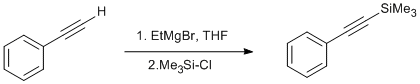
Silylation of Phenylacetylene
SyntheticPage 505
DOI:
Submitted: August 28, 2011, published: September 5, 2011
Authors
Christopher Kelly (christopher.b.kelly@uconn.edu)
A contribution from
Chemicals
Chlorotrimethylsilane (Wacker quality, ≥99.0% (GC), Purchased from Sigma-Aldrich)
Tetrahydrofuran (anhydrous, ≥99.9%, inhibitor-free, Purchased from Sigma-Aldrich)
Phenylacetylene (98%, pure, Purchased from Acros Organics)
Procedure
To a flamed dried 250 mL one-neck round bottom flask equipped with stirbar, septa, and nitrogen inlet needle was added phenylacetylene (4.1 g, 0.040 mol, 1 equiv.) in THF (25 mL, 1.6 M in the alkyne) via a gastight syringe. The flask was cooled to -78 oC in a dry-ice/acetone bath. After cooling for 10 minutes, EtMgBr (60 mL, 0.060 mol, 1.5 equiv.) was added dropwise to the solution. Upon completion of addition, the mixture was stirred for 30 min. The solution was then warmed to 0 oC in a ice-water bath and stirred for 30 min. TMS-Cl (4.35 g, 0.040 mol, 1 equiv.) was added to the solution dropwise. The solution was stirred for 10 min after complete addition of TMS-Cl.. The ice-water bath was then removed and the solution was allowed to warm to room temperature for 30 min. The reaction mixture was carefully quenched1 by the addition of 60 mL of 1 M HCL (CAUTION: Exothermic). Upon complete addition, the biphasic mixture was transferred to a 1000 mL separatory funnel. The phases were separated and the aqueous layer was extracted with hexanes (3 x 100 mL). The combine organic layers were washed with brine and dried with Na2SO4. The solvent was removed in vacuo to afford a crude yellow-orange oil. Further purification was accomplished by vacuum distillation ( 57-61 oC @ 1 mmHg) to give pure trimethyl(phenylethynyl)silane (5.65 g, 81%).
Author Comments
Data
1H NMR (400 MHz, CDCl3) δ ppm 0.29 (s, 9 H), 7.29 - 7.38 (m, 3 H), 7.45 - 7.56 (m, 2 H)
Lead Reference
Other References
Supplementary Information
Keywords
alkynes, Organosilane, Silylation, substitution